We will call you back
I was looking for a good team to run our website. I wanted someone who would know what to do to turn it into profit and enquiries from new clients. Igor and his team are exactly those specialists.


Your customers are increasingly looking for answers in AI tools, not just on Google. ChatGPT Ads are a way to showcase your brand at the exact moment a user is asking questions, comparing options, and making decisions. AI can organize and analyze data, automate repetitive tasks, manage reminders and workflows, support sales, marketing, and customer service teams, and integrate with your existing systems.

Most traffic from ChatGPT ads comes from mobile devices. If your mobile site doesn't deliver, your ad budget disappears faster than the user can make a decision.
Purchases and lead generation rarely happen at a desktop computer these days. They happen in the evening, on the go, with a phone in hand. The phone is the moment of decision, not the computer screen.
Page layout, content, and CTAs must be designed for mobile and conversion. If your mobile site design doesn't guide the user to their goal, sales simply drop off.
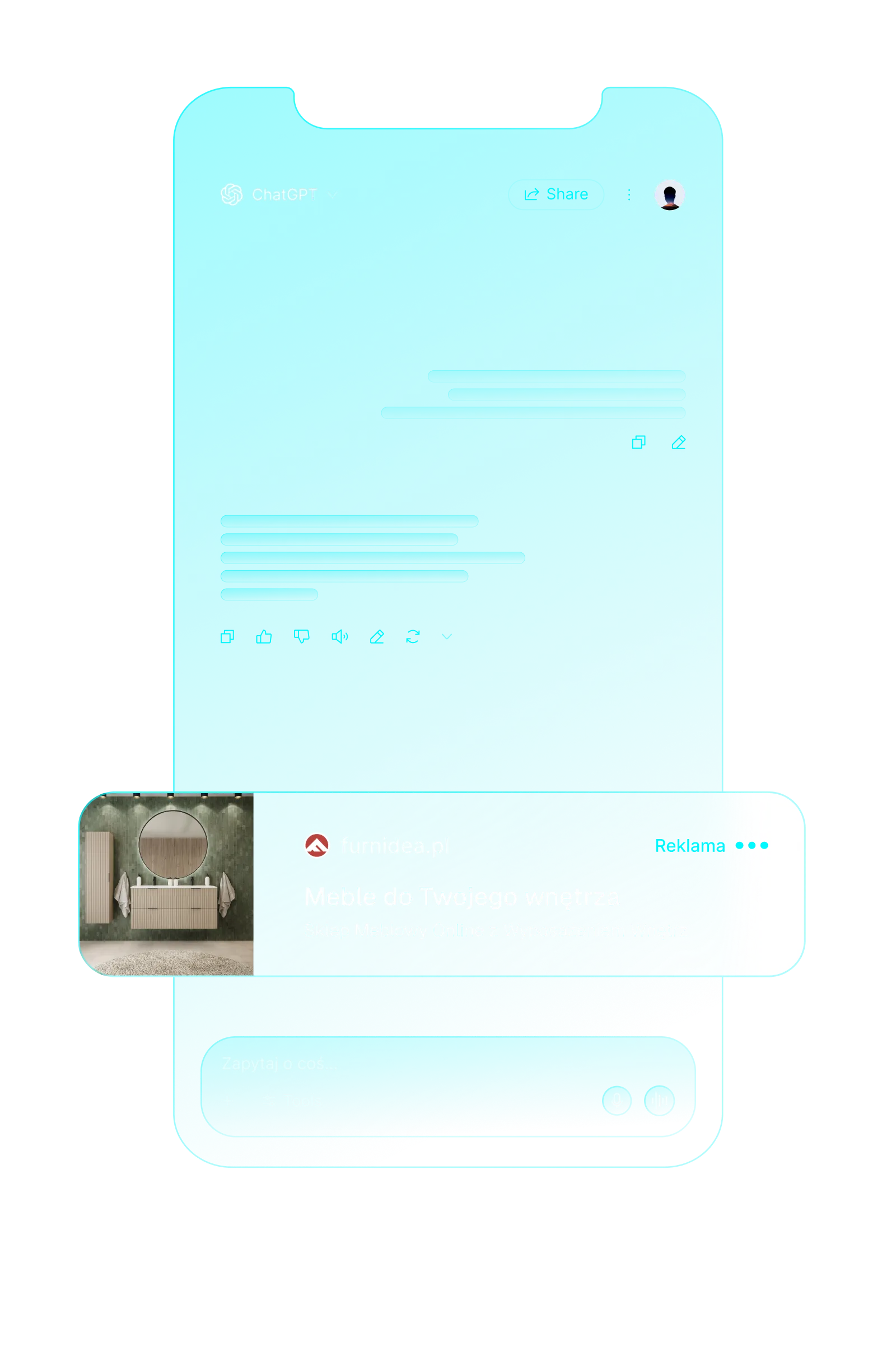
When a user asks ChatGPT about a product or service, compares available options, or searches for a specific solution, your company’s ad can appear right below the ChatGPT response—tailored to the conversation and clearly marked as sponsored content.
We don't treat ChatGPT Ads as just another ad placement. It’s a channel for brands that want to show up when a user is asking questions, comparing options, and looking for a specific solution. That’s why we start with intent, your offer, and your landing page, rather than just the budget.
When a customer is comparing products, models, or specific solutions, you can appear closer to the point of purchase—not just when they land on Google.
ChatGPT is increasingly helping people choose a specialist, a company, or a way to solve a problem. Your ad can appear at that exact moment.
In B2B, the decision process rarely starts with a form. It begins with research, comparing options, and internal discussions. ChatGPT Ads can be part of that stage.
If Google and Meta are already saturated, ChatGPT Ads could be the next place to test demand, with budget control and clear performance tracking.
The more a customer needs to understand before making a purchase, the more important it is to be present during their research phase. ChatGPT Ads help you join that conversation earlier.
ChatGPT Ads are still a new channel, so companies that start testing them before the space gets crowded may have a competitive edge.
We start by checking if this channel makes sense for your brand.
Result: We know what is worth testing in ChatGPT Ads and where this channel can realistically help with sales or lead generation.
We configure campaigns for maximum effectiveness.
Result: The campaign is ready to launch, and we know exactly which data points we will be monitoring from day one.
We launch the campaigns, monitor the data, and optimize.
Result: Based on the initial data, we know whether to scale the campaign, refine our assumptions, or change the direction of the test.

ChatGPT Ads campaigns at Sky are managed by Paulina, who combines her performance marketing expertise with testing the capabilities of this new advertising system. Using data-driven insights, she evaluates which contexts effectively reach the right audience, which messages drive action, and whether the generated traffic converts into sales or high-quality leads. Rather than relying on pre-set assumptions, she develops every campaign based on real-world results—from initial testing and optimization to scaling for growth.
MEET THE SKY TEAMEvery month, you get a clear picture of your results along with an analysis of the situation
Regular online meetings to discuss results, priorities, and actions
You talk to the specialist who is actually managing your project
You have constant contact with the team via a shared messenger
Clear terms of cooperation. We retain clients with results, not contracts
We suggest directions, tests, and moves that make sense
Strategy, creative, performance, web, and analytics under one roof
We speak clearly, concretely, and without agency jargon


Since we started working with Igor and his team, the store we work on has genuinely grown and, above all, we understood that advertising can be done far better, smarter and more effectively. This is a partnership focused on growth and numbers, not empty promises.


Sky Agency is our third marketing company and we hope it will be the last. They run marketing for our two clothing brands and from the very beginning we felt they treat our cooperation in a truly individual way. Beyond marketing itself, they also help us grow the companies and look at everything much more broadly. What we value most is the communication. It is fast, to the point, and we constantly feel that someone is on top of things. There is never a problem getting an answer or discussing new ideas. You can tell this is built by people who genuinely put their heart and commitment into their work. Working like this simply feels calm and supported, and that matters a lot to us!

I have worked with Sky Agency for several years on various projects – a website, recruitment process automation, SEO. If I had to sum it up in one sentence: this is an agency where there is a real person behind the words, someone who takes responsibility. Igor as CEO does not disappear behind the team when things get difficult. That is rare and I value it. Together we built a tool for managing the recruitment of event staff – an application form, a candidate verification panel, automatic notifications, email integration. It sounds simple. At a scale of several hundred contractors a year and with the specifics of temporary work, it was a complex, non-standard brief. And I will say more: in difficult moments you see who you are really working with. And I do. I recommend them – especially to companies with non-obvious needs looking for someone who will dig deeper than a slide deck.

I recommend working with Sky Agency. Despite a very complex project requiring many custom solutions and integrations, everything was delivered professionally and in line with our expectations. The team stayed engaged throughout the whole process, and all key revisions were implemented until the final result was achieved.
.jpg)
We have been working with Sky Agency since 2022 – SEO, the rmcpolska.pl website and IT development support. More than four years of steady, well-organised cooperation. Igor and the team understood the specifics of our industry and are responsible for growing our online presence – from SEO to the new website we are designing together. IT tickets are handled quickly and without downtime. We value their straightforwardness, industry knowledge and partnership approach. We recommend them to any company looking for an agency that combines marketing with the technical side of business.









ChatGPT Ads in Poland is no longer a futuristic concept or an industry announcement on which one can only speculate. Ads in ChatGPT are just entering the European market, and Poland is among the countries covered by the service expansion. According to the current OpenAI list, Polish advertisers can already use the self-service Ads Manager system. However, it is worth maintaining the right perspective: we are still dealing with a solution being developed in beta, whose capabilities, formats, and delivery system may change along with the data collected by OpenAI. There are no universally accepted performance benchmarks for individual industries yet, so the first ChatGPT Ads campaigns should be treated not as a ready-made replacement for Google Ads or Meta Ads.
Why does the appearance of ads in this specific environment arouse so much interest? ChatGPT is not a classic search engine or a social media site where a user browses content primarily for entertainment. Very often, it acts as an advisor supporting research, comparing options, and making decisions. A user can describe not only what they are looking for but also their situation, limitations, expectations, and doubts. Instead of typing a slogan consisting of a few words, they conduct a conversation, ask follow-up questions, and gradually refine the need. It is precisely the context of such a conversation that can allow the system to better recognize the moment when a specific company's, product's, or service's proposal will be truly useful.
Does this mean that every brand should immediately move part of its budget to OpenAI Ads? Not necessarily. Early entry gives the opportunity to gain experience before the market becomes more competitive, but it also involves greater uncertainty. There is still a lack of stable comparative data, ready-made campaign schemas, and the years of optimization knowledge that we have in the case of mature advertising platforms. ChatGPT marketing will therefore require a readiness to form hypotheses, conduct tests, and evaluate real business results. The advantage does not have to be gained by the company that launches ads first. It can, however, be gained by the organization that is one of the first to learn to understand this channel and make decisions based on its own data.
Ads in ChatGPT appear below the responses generated by the system and are clearly separated from them. An ad unit can contain the advertiser's name, logo, headline, description, graphic, and a link leading to the landing page. The user therefore receives the correct ChatGPT response first, and only below it can they see the marked sponsored content. This is an important distinction because an ad in ChatGPT does not give the advertiser the ability to buy a specific model response or influence the recommendations formulated in its content. OpenAI declares that responses remain independent of the advertising system, and advertisers do not receive access to users' private conversations.
The way an ad is delivered is one of the most important differences between ChatGPT Ads and classic search engine campaigns. In Google Ads, the starting point is usually a specific query entered by the user. In ChatGPT, the broader context of the current conversation can matter. Imagine a person who doesn't just ask for "running shoes," but describes distances, the type of surface, previous problems with footwear, and the planned budget. For the advertising system, this is a much more extensive picture of a purchasing need than a single phrase. OpenAI allows advertisers to add so-called context hints, i.e., hints describing the types of conversations, topics, and intents in which the offer might be useful. However, they are not a simple equivalent of keywords in exact match and do not guarantee that an ad will appear in every conversation that meets the given criteria.
Do keywords therefore stop having meaning? No. Rather, the way we should think about them changes. Instead of concentrating the entire strategy on a short list of queries, ChatGPT advertising campaigns may require a more accurate understanding of the user's problems, situations, and goals. A good ad group should not only describe what the company sells. It should also define when its offer constitutes a sensible answer to a need appearing in the conversation. In practice, this means moving from keyword intent, i.e., the intent assigned to a phrase, toward conversational intent - the intent resulting from the entire course of the conversation.
Not every conversation qualifies for the display of sponsored content, and not every user will see an ad. OpenAI informs that ads can be presented to users of Free and Go plans, while paid Plus and Pro plans, as well as Business, Enterprise, and Edu plans, remain ad-free. The system also takes into account restrictions related to, among other things, the user's age, the topic of the conversation, and policies regarding acceptable ad categories. Simply launching a campaign therefore does not mean unlimited access to the entire ChatGPT user base. Potential reach depends on available inventory, campaign settings, message relevance, and the number of conversations to which the offer can be qualified.
This is where the biggest challenge for advertisers appears. A company's ad in ChatGPT should not just attract attention. It must fit the situation in which the user sees it. A generic message like "Highest quality - check the offer" can look particularly weak next to a detailed, substantive conversation devoted to a specific problem. An effective ad should provide a natural next step: show an adequate product, answer a recognized need, or present a benefit that matters in a given context. It is precisely relevance, not just appearing in a new channel, that can decide whether a user treats the ad as a helpful proposal or as an element disrupting the conversation.
At first glance, ChatGPT Ads may resemble another advertising system where a company sets a budget, prepares creatives, and competes with other advertisers for the recipient's attention. The basic elements are indeed familiar to those running Google Ads or Meta Ads campaigns. You still need to choose a goal, divide the offer into logical ad groups, set maximum bids, prepare messages, and direct the user to the appropriate landing page. However, the biggest change does not concern the advertising panel itself. It concerns the way the system recognizes the situation in which an ad might prove useful.
In classic search campaigns, a large part of the strategy is based on phrases entered by the user. The advertiser analyzes keywords, assigns them intent, sets match types, and excludes queries that do not correspond to the offer. ChatGPT advertising campaigns introduce a different approach. The advertiser can provide the system with context hints describing the product, the recipient, and the situations in which a given offer is applicable. These hints help define the thematic area of the ad group, but they do not work like keywords in exact match. We do not have a simple mechanism: the user used the indicated phrase, so the system must display a specific ad.
This is well illustrated by the difference between the phrase "project management software" and the description "a tool for a small agency that manages a dozen projects simultaneously, wants to control team deadlines, and needs simple work time reporting." The first variant names the product category. The second presents the recipient, their problem, and the context of using the solution. It is precisely such detailed descriptions that can help the algorithm understand during which conversations a given offer will be relevant. Configuring ChatGPT Ads therefore requires not only knowledge of the product but also the ability to translate knowledge about the customer into specific needs and purchasing scenarios.
This does not mean that existing knowledge in the field of PPC campaigns loses its significance. On the contrary - business goals, offer segmentation, cost control, message testing, landing page optimization, and conversion analysis remain with us. However, the role of simple thinking about the user solely through the prism of a single query decreases. A ChatGPT Ads specialist must understand both the mechanics of advertising systems and the language that customers use to describe their problems. This is a combination of performance marketing, intent analysis, and knowledge about the recipient's decision-making process.
It is also worth remembering that relevance is not the only factor determining delivery. OpenAI ads participate in an auction where, among other things, ad fit, content, landing page, context hints, and the advertiser's maximum bid matter. OpenAI describes this mechanism as a second-price auction weighted by relevance. In practice, a high bid may increase the competitiveness of a campaign, but it does not guarantee that the ad will be displayed in every available conversation. The system is intended to take into account both the value for the advertiser and the potential usefulness of the message for the user. Therefore, a well-prepared campaign does not start with answering the question "how much are we willing to pay?", but with determining "in what situation does our offer actually help?".
Every ChatGPT Ads campaign has a three-level structure including the campaign, ad groups, and individual ads. At the campaign level, we define, among other things, the goal, budget, duration, and markets where we want to conduct activities. The ad group organizes the offer around a specific product, thematic area, or customer need. At the lowest level are the creatives containing the headline, description, graphic, and landing page URL. The schema is therefore clear to those familiar with other advertising platforms, but the way individual levels are used should be adapted to the specifics of conversations conducted in ChatGPT.
The first step should be to determine what result the launch of a ChatGPT Ads campaign is intended to bring. OpenAI currently provides CPM, CPC, and oCPC models. CPM campaigns are primarily used for building reach and charge the advertiser for a thousand impressions. In CPC campaigns, the fee is charged for a valid click, so this model is better suited for activities focused on acquiring traffic. oCPC also charges for clicks, but the system optimizes delivery with a selected conversion event in mind. This could be, for example, a purchase, registration, or form submission. However, the choice of oCPC does not mean payment per conversion - the advertiser still incurs the cost of the click.
The choice of goal affects the further configuration of ChatGPT Ads, so it should not be made based on which model sounds the most advanced. A reach campaign may be justified when introducing a new brand or product, but it will not directly answer the question about the cost of customer acquisition. A CPC campaign will allow you to check whether the ad generates interest and valuable traffic, but the click itself is not yet a business result. In turn, using oCPC optimization makes sense only when conversion measurement has been correctly configured and the selected event actually represents value for the company. Without this, the algorithm may optimize activities for a signal that looks good in a report but has little significance for sales.
The next stage is dividing the offer into ad groups. Each of them should focus on one consistent product, application, or area of intent. Combining many unrelated services in one group makes it difficult to create relevant context hints, match messages, and choose the right landing page. If a company offers a CRM system for both small sales teams and large organizations, these could be two different scenarios requiring separate arguments. Similarly, advertising products in ChatGPT should take into account differences between categories, customer needs, and stages of the purchasing decision, instead of directing all conversations to the general store page.
Within each group, it is worth preparing several truly different ads. This is not about changing a single word in the headline, but about testing different arguments. One message can emphasize time savings, another the simplicity of implementation, and a third a specific function that addresses a user's problem. Thanks to this, the system receives a larger selection of content that it can match to different situations. At the same time, the advertiser gains the ability to check which value propositions attract attention and lead to valuable actions after clicking.
The last step before launch is verifying the entire user path. Even a well-matched ad will not fix a site that loads too slowly, does not answer the promise in the message, or makes it difficult to perform the expected action. Running ads in ChatGPT does not end with preparing the campaign in the panel. It also includes configuring analytics, tagging links with UTM parameters, implementing conversion measurement, and checking the website for usability and consistency of communication. Only by combining these elements can you assess whether the campaign provides real value, and not just impressions and clicks.
ChatGPT Ads Manager is a panel where an advertiser can create an account, configure billing, prepare campaigns, submit them for review, and control their subsequent delivery. The system is still being developed as a beta solution, so its current scope does not necessarily correspond to the final version of the platform. However, it already provides the basic functions necessary for independently running ChatGPT Ads campaigns - from setting budgets and maximum bids to organizing ad groups and analyzing effects at the campaign, group, and individual creative levels.
Launching a campaign can be done directly in the panel step-by-step or via bulk import prepared according to the OpenAI schema. The first method works well when creating smaller campaigns and getting to know the system. Bulk import, on the other hand, facilitates work on a larger number of ad groups and creative variants. Regardless of the chosen method, campaigns and ads must go through a verification process. Their delivery may be limited by, among other things, non-compliance with advertising policies, issues with business verification, lack of required billing settings, or a bid that is not competitive enough.
The ChatGPT Ads Manager provides data on the number of impressions, clicks, spending, CTR, average CPC, average CPM, and conversions, if their measurement has been configured. Results can be viewed in tables, analyzed on charts, and exported to CSV files. This allows you to monitor the pace of budget spending and compare the effects of individual campaign elements. However, the panel itself will not automatically answer the question of whether the ads are profitable. CTR can tell you whether the message encourages clicking, and average CPC will show the cost of acquiring a visit. Only by comparing this data with conversions, revenue, and the quality of acquired leads can you assess the impact of the campaign on the business.
Managing ads in ChatGPT should therefore include not only regular checking of the values visible in the Ads Manager but also data analysis in the company's other tools. Traffic can be tagged with UTM parameters and monitored in an analytics system, while the quality of leads should also be assessed based on data from forms, CRM, or the sales team. If an ad generates many cheap clicks, but users quickly leave the site or send irrelevant inquiries, it is difficult to consider it effective. The advertising panel provides the signals needed to make decisions, but the proper interpretation of these signals remains the task of the advertiser or the ChatGPT Ads agency managing the activities.
In advertising systems, it is easy to assume that the company with the highest budget has the greatest advantage. In the case of OpenAI ads, the bid is an important element of the auction, but it does not work in isolation from the quality and relevance of the entire campaign. The system analyzes more than just the maximum amount the advertiser is willing to pay. The content of the ad, the landing page, the provided context hints, and the predicted fit of the offer to the user's situation can also be taken into account. Increasing the bid may therefore increase the chance of participating in the delivery, but it should not replace work on the campaign structure and its communication.
This has significant consequences for companies that want to quickly increase the reach of their OpenAI advertising campaigns. If the context hints are too general, the ad does not present clear value, and the landing page only loosely corresponds to the promise made in the message, a high budget does not solve the fundamental problem. The ad may be less useful to the user, and the acquired clicks may end in short visits without further action. Paying more for traffic makes little sense if the recipient does not find the solution they were looking for after landing on the page.
Relevance should be built at every level of the campaign. A context hint describes the user's situation, the headline signals a specific value, the expansion complements the message with an important argument, and the landing page allows the user to verify the offer and take the next step. Each of these elements should lead the recipient in the same direction. If the ad promises a cost calculator, the click should not lead to a general homepage where the user has to search for the tool themselves. If the message concerns a specific product, the natural destination would be that product's page or a properly prepared category, not the full store catalog.
It is worth looking at relevance more broadly than just as a way to improve auction results. A person conducting a conversation with ChatGPT usually expects an answer related to a specific problem. An ad that is not matched to this context may be perceived as particularly random and intrusive. Conversely, a message that expands on the topic of the conversation and presents an adequate option has a chance to become a useful element of the decision-making process. The question is therefore not just: "How do I win the auction?". It is much more important to ask: "Is it worth winning the impression in this specific situation, and what should the user see after clicking?".
Optimizing ChatGPT Ads campaigns should include both working on bids and systematically testing relevance. If an ad group is getting low reach, the reason does not always have to be a too-low maximum CPC or CPM. The problem may stem from a narrow or unclear description of the product's application, a mismatched creative, errors on the landing page, or a limited number of conversations corresponding to a given scenario. Before increasing the budget, it is worth checking the entire path and determining at which stage the campaign is losing potential.
How do you advertise in ChatGPT without sounding like a random banner attached to a substantive answer? The starting point should be a concrete and honest message. OpenAI recommends that an ad clearly present the practical value of the product, indicate who it might be useful for, and avoid general slogans that say little about the offer. In a conversational environment, overly promotional language can contrast particularly strongly with the way a user conducts a conversation and searches for information.
The headline should explain as quickly as possible what the advertiser is offering or what result the recipient can achieve. Slogans like "Meet the future," "Choose the highest quality," or "An offer created for you" sound impressive but don't allow one to assess whether the product has any connection to the current need. A message that names the solution category and presents a clear benefit works much better. However, this is not about creating a long description. Space for a headline is limited, so every word should serve a specific function.
The ad description should not repeat the headline in other words. This is the place to expand on the value proposition, present an application, an important feature, or an argument that facilitates decision-making. If the headline informs about an invoice automation tool, the description can indicate supported document formats, the possibility of integration with an accounting system, or the time needed to get started. Thanks to this, the entire ad conveys more information and helps the user decide whether it is worth visiting the site.
The graphic serves a similar function. It should support the message and make it easier to recognize the product, rather than fighting for attention with random visual elements. In the case of a physical product, a clear photo showing the correct variant is a natural choice. For software, a fragment of the interface or a simple visualization of the most important function might work well. OpenAI recommends images that are easy to interpret, consistent with the text, and free of excessive visual chaos. The user should understand the message without wondering what the creative actually represents.
One correct ad is not enough to reliably assess the potential of the communication. OpenAI recommends creating many diverse variants that show the offer from different perspectives. This does not mean preparing ten almost identical headlines. If every variant is based on the same argument, the system does not receive truly new opportunities to match the ad. It is better to test different needs and benefits: time savings, ease of implementation, a specific function, no long-term contract, availability of a demo version, or solving a problem characteristic of a specific group of customers.
This is where the importance of a good strategy returns. Creating ads should not start with the question "What slogan will be the catchiest?", but with determining why a user might be interested in the product during a given conversation. Only on this basis can you build creatives that correspond to different scenarios. An ad aimed at a person who is just getting to know the available solutions may serve a different function than a message intended for a user comparing specific variants and ready to purchase. Both people may be interested in the same category but need different arguments.
How do you launch ads in ChatGPT that have a chance to bring in valuable traffic? You need to ensure continuity between the conversation, the creative, and the landing page. The ad cannot promise something that the user will not find after clicking. The landing page should immediately expand on the topic from the ad, answer the most important doubts, and clearly lead to the expected action. Only such consistency allows for evaluating the effectiveness of the message itself. If the site is not prepared to receive traffic, even a high CTR can lead to the false conclusion that the campaign is working well. If you are considering investing in marketing activities, it is worth asking yourself first whether it might be necessary to create an online store that will support sales and not limit you in your future strategy.
E-commerce ads in ChatGPT can have particular potential where a purchase is preceded by comparing products, analyzing parameters, or looking for a solution tailored to a specific application. A user might ask for a laptop for graphic design, a cosmetic suitable for a specific skin type, gear for a first mountain trip, or a coffee machine that fits a small kitchen and a set budget. In each of these cases, the conversation provides information that can help better understand the need than simply having the user land on a general product category.
OpenAI allows for the creation of campaigns based on product feeds, which are structured files containing information about a store's assortment. The feed can include, among other things, product names, descriptions, photos, prices, promotional prices, availability, and landing page URLs. Thanks to this, advertising products in ChatGPT does not have to be done manually for every item in the catalog. The system can use structured data and present products eligible for display in a format designed for e-commerce.
The catalog can be provided to the Ads Manager via a CSV or TXT file, a hosted URL, or an SFTP connection. Manually uploading a file might be enough during initial tests with a small and stable offer. For larger stores, an automatic update is a better solution because data regarding prices, promotions, and availability quickly becomes outdated. A product that cannot be purchased or whose price in the ad differs from the price on the site not only reduces the chance of a sale but can also lower trust in the store and the entire campaign.
However, simply connecting a feed does not mean that all products should be in one ad group. It is worth organizing the assortment by category, application, margin, seasonality, or other features relevant to your sales strategy. A sports store might separate products for beginners from professional equipment, and an electronics retailer might separate devices intended for work, entertainment, and professional use. Such a division makes it easier to control bids, analyze results, and assess which parts of the catalog best match the way ChatGPT is used.
A product feed should be treated as a source of information for the system, not just a technical file required to launch a campaign. A generic product name, a poor description, or the lack of important parameters limits the ability to properly understand the offer. It is therefore worth ensuring clear titles, correct categorization, legible photos, and data describing features that may influence a customer's choice. If two products differ in capacity, material, purpose, or compatibility, this information should be easy to read for both the user and the advertising system.
You should also clearly separate product ads from the organic presence of products in ChatGPT responses. OpenAI notes that in the current beta version, uploading a feed to the Ads Manager qualifies products for use in advertising campaigns but does not cause them to appear automatically in regular, non-sponsored conversations. Company advertising in ChatGPT and SEO are two separate areas. Advertising budget should not be presented as a way to influence the model's responses or as a guarantee of product recommendations outside of the designated advertising space.
Will product campaigns work for every online store? Not necessarily. The greatest value can be gained in categories where the customer needs help choosing, analyzes several options, or describes their requirements before purchasing. For very simple, impulsive products, the advantage of a conversational environment may be smaller. That is why it is worth starting e-commerce ads in ChatGPT with a selected part of the catalog, a controlled budget, and a clearly defined hypothesis. Only data will show whether users acquired during a conversation buy more often, choose higher-value products, or make more informed decisions than recipients from other channels.
ChatGPT Ads is a new advertising system, so we won't try to convince you that we've been running campaigns on it for years or that we have a ready-made recipe for success in every industry. No ChatGPT Ads agency has that kind of experience yet. What we can do, however, is leverage competencies that are directly relevant to this channel: performance campaign planning, user intent analysis, ad copy creation, landing page preparation, analytics configuration, and performance evaluation based on business data.
We start running ChatGPT Ads campaigns by getting to know your offer and determining the situations in which it can be helpful to users. We then translate this information into a campaign structure, ad groups, context hints, and diverse creatives. We also ensure that the ad leads to the right subpage, rather than a random address that forces the recipient to search for the product or service they are interested in all over again. If the landing page requires changes, we point out elements that may limit conversion and help prepare it to receive new traffic.
Managing ads in ChatGPT also includes configuring measurement, controlling spending, and analyzing data at the campaign, ad group, and individual creative levels. We don't evaluate performance solely based on the number of impressions or a low cost-per-click. We check whether the acquired traffic leads to inquiries, registrations, purchases, or other actions that matter to your business. As a result, optimizing ChatGPT Ads campaigns can involve not only bids and budgets but also messaging, context hints, account structure, and the entire path from ad to conversion.
At the current stage of the platform's development, a test-driven approach is particularly important. Instead of assuming from the start that OpenAI Ads will turn out to be a breakthrough source of sales, we define hypotheses, prepare a test budget, and check the channel's potential using real data. If the results justify further investment, we develop the campaign and scale it up. If not, we analyze the reasons and decide whether it's worth changing the strategy or allocating the budget to other activities. Managing ChatGPT Ads campaigns should be based on insights, not on the excitement surrounding the emergence of a new platform.
Do you want to see if advertising in ChatGPT can find a place in your company's marketing strategy? Let's talk about your offer, your audience, and your business goals. We will help you assess the channel's potential, launch your ChatGPT Ads campaign, and grow it based on data collected from the very first days of delivery.
Do you have a store, service, or brand you want to genuinely grow online?
Head over to our simple contact form and let us know what you need today.
We will get back to you with a concrete proposal for next steps and a time for a brief call.