We will call you back
I was looking for a good team to run our website. I wanted someone who would know what to do to turn it into profit and enquiries from new clients. Igor and his team are exactly those specialists.


Users are clicking on search results less and less. They ask ChatGPT, Gemini, Perplexity, and Google AI Overview and get a ready-made answer. If your brand doesn't appear in these answers, you don't exist for a growing group of potential customers.
We help you change that.

In campaigns on Meta, Instagram, or TikTok, the majority of traffic comes from phones. If your mobile site doesn't deliver, your budget disappears faster than the user can make a decision.
Shopping and leaving contact details rarely happen at a computer these days. They happen in the evening, on the go, with a phone in hand. The phone is the moment of decision, not the computer screen.
Page layout, content, and CTAs must be designed with the user's phone and sales in mind. If a mobile site design doesn't guide the user to their goal, sales simply drop off.
Everything we do is measurable. We implement full tracking from day one so that decisions are based on data, not gut feeling. We know where your customers come from, how much it costs to acquire them, and which actions actually drive results.
This is the foundation of every project we manage.




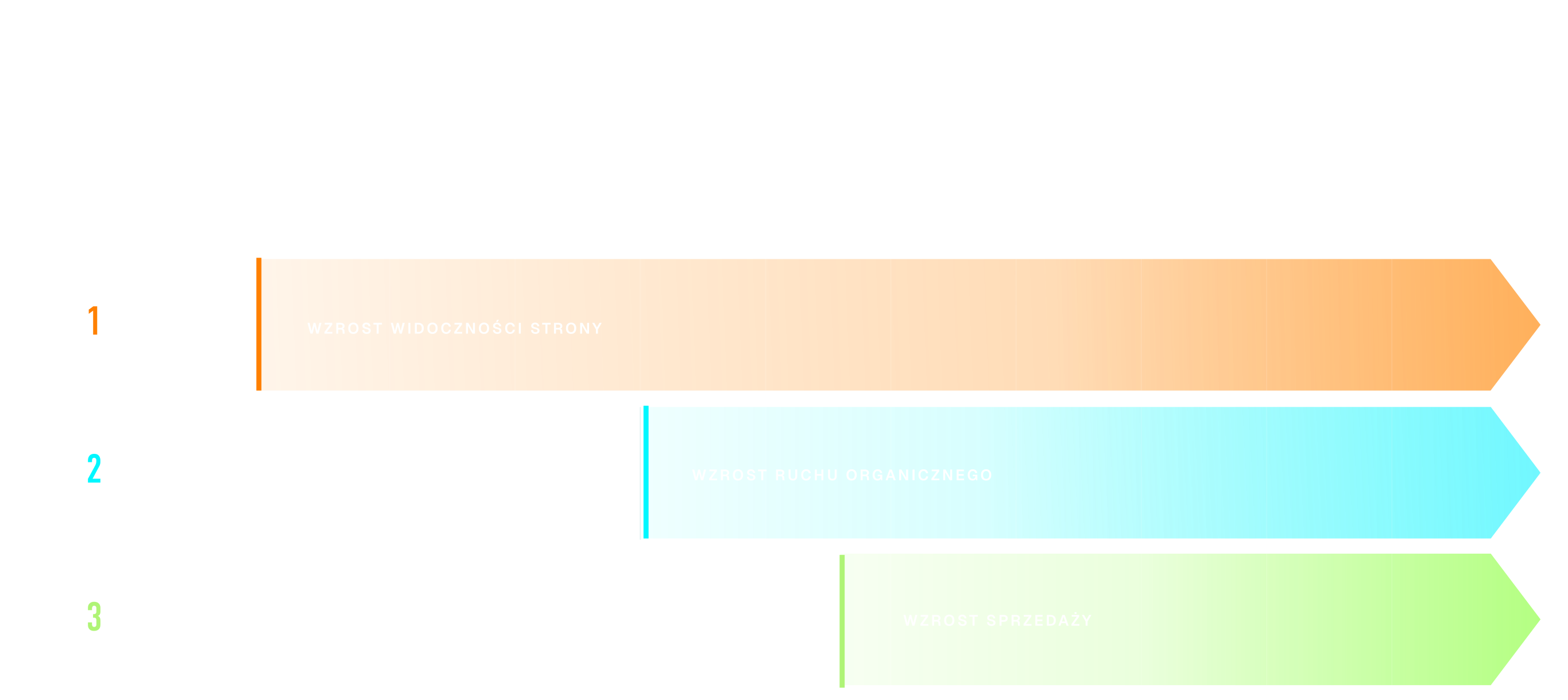
SEO doesn't follow a fixed calendar.
The chart shows estimated stages based on our projects.
In AI-driven SEO, the first results are usually seen in content quality and how tools begin to understand your brand.
Over time, the likelihood of your site being cited as a source for answers increases. This is influenced by the topic, competition, content freshness, and your brand's existing digital footprint.
We check if AI sees your brand
GOAL: To see if your brand appears in AI answers and where it is losing ground to competitors.
We identify the questions you should be answering
GOAL: Focus SEO efforts on areas with real business potential, rather than just generating empty traffic.
We organize content for AI models
GOAL: Build a technical foundation that allows SEO to grow steadily and without roadblocks.
We organize content for AI models
GOAL: Increase organic visibility and strengthen the brand's position in its industry.
We monitor how brand presence evolves
GOAL: Translate SEO efforts into long-term growth in sales and inquiries.
Robert is responsible for SEO strategy and its execution in Sky projects.
He is the one who analyzes data, makes decisions, and ensures that SEO genuinely supports sales and leads. He doesn't delegate key areas to a "team," but personally oversees the direction of activities and the quality of implementation. This way, you know who is responsible for your results and
who you are talking to about the results.
Every month, you get a clear picture of your results along with an analysis of the situation
Regular online meetings to discuss results, priorities, and actions
You talk to the specialist who is actually managing your project
You have constant contact with the team via a shared messenger
Clear terms of cooperation. We retain clients with results, not contracts
We suggest directions, tests, and moves that make sense
Strategy, creative, performance, web, and analytics under one roof
We speak clearly, concretely, and without agency jargon


Since we started working with Igor and his team, the store we work on has genuinely grown and, above all, we understood that advertising can be done far better, smarter and more effectively. This is a partnership focused on growth and numbers, not empty promises.


Sky Agency is our third marketing company and we hope it will be the last. They run marketing for our two clothing brands and from the very beginning we felt they treat our cooperation in a truly individual way. Beyond marketing itself, they also help us grow the companies and look at everything much more broadly. What we value most is the communication. It is fast, to the point, and we constantly feel that someone is on top of things. There is never a problem getting an answer or discussing new ideas. You can tell this is built by people who genuinely put their heart and commitment into their work. Working like this simply feels calm and supported, and that matters a lot to us!

I have worked with Sky Agency for several years on various projects – a website, recruitment process automation, SEO. If I had to sum it up in one sentence: this is an agency where there is a real person behind the words, someone who takes responsibility. Igor as CEO does not disappear behind the team when things get difficult. That is rare and I value it. Together we built a tool for managing the recruitment of event staff – an application form, a candidate verification panel, automatic notifications, email integration. It sounds simple. At a scale of several hundred contractors a year and with the specifics of temporary work, it was a complex, non-standard brief. And I will say more: in difficult moments you see who you are really working with. And I do. I recommend them – especially to companies with non-obvious needs looking for someone who will dig deeper than a slide deck.

I recommend working with Sky Agency. Despite a very complex project requiring many custom solutions and integrations, everything was delivered professionally and in line with our expectations. The team stayed engaged throughout the whole process, and all key revisions were implemented until the final result was achieved.
.jpg)
We have been working with Sky Agency since 2022 – SEO, the rmcpolska.pl website and IT development support. More than four years of steady, well-organised cooperation. Igor and the team understood the specifics of our industry and are responsible for growing our online presence – from SEO to the new website we are designing together. IT tickets are handled quickly and without downtime. We value their straightforwardness, industry knowledge and partnership approach. We recommend them to any company looking for an agency that combines marketing with the technical side of business.









The way people search for information is changing faster than search results themselves. Users increasingly do not want to browse ten links, compare several websites, and piece together an answer on their own. They want to ask ChatGPT, Gemini, Perplexity, or Google AI Overview and receive a ready-made summary.
This changes the logic of brand visibility. In classic SEO, you fight for a position in Google results. In AI positioning, you fight for something else: for your brand, content, product, service, or expertise to be selected as the source of the answer.
If a user asks an AI for the best solution, a service comparison, a provider choice, a tool recommendation, or an explanation of a problem, and your brand does not appear in the response, you may be losing contact with the customer before they even enter a search engine. It is no longer just about ranking high in Google. It is about being a recognizable, credible, and quotable source for the systems that increasingly act as intermediaries between a user's query and their purchasing decision.
AI positioning is the work of managing brand visibility within AI-generated responses. It encompasses classic SEO, content structure, technical data, domain authority, topical authority, citations, mentions, E-E-A-T, and the way content is written. Language models must not only find your site; they must also understand that it is worth using.
AI positioning is the process of optimizing your website, content, and online brand presence so that generative tools can more easily find, understand, evaluate, and cite your information in their responses.
In practice, this means preparing content for systems like Google AI Overview, ChatGPT, Gemini, Perplexity, and other AI assistants. Each of these environments operates slightly differently, but they share one common trait: they do not present the user with a traditional list of results in the same model as a classic search engine. Instead, they synthesize an answer by selecting sources they deem relevant, credible, and well-suited to the context of the query.
Google describes AI Overviews as AI-generated summaries with links that allow users to explore a topic in greater depth. This means that visibility in such a space may become a new layer of organic presence, distinct from a classic top 10 ranking.
AI positioning does not replace SEO; it expands it. Without a technically sound website, good content, domain authority, and trust, it is difficult to talk about visibility in AI. The difference is that in GEO and AIO, we don't just optimize for rankings. We optimize for understanding, citation, and source selection.
Several terms are emerging around AI positioning that are often used interchangeably, even though they describe different elements of the same shift.
GEO, or Generative Engine Optimization, means optimizing for generative answer engines. The goal is for content to be well-understood and selected by systems like ChatGPT, Gemini, Claude, or Perplexity. GEO focuses on citability, knowledge structure, relevance, authority, and whether a brand can be considered a valuable source.
AIO can be understood as efforts focused on AI Overviews—the AI-generated responses directly in Google results. This is a critical area because AI Overviews appear where users previously saw classic organic results. If your site is used as a source, it can gain visibility above traditional links. If it isn't included, the user may receive an answer without ever encountering your brand.
AEO, or Answer Engine Optimization, focuses on optimizing for answer engines. This area concentrates on ensuring content provides clear, direct, and structured answers to user questions.
These concepts have different nuances, but in practice, they lead to one goal: the brand must be easy to understand, credible, well-described, and present where AI looks for sources.
For years, the fundamental question in SEO was, "What is our ranking?" Today, we increasingly need to add a second one: "Does AI see us at all?"
Users are changing how they search. Instead of typing short phrases, they are increasingly asking full questions. Instead of comparing results themselves, they ask a tool for recommendations, summaries, lists of options, or explanations. Instead of opening multiple websites, they often read a single answer.
This direction is strongly emphasized on the new subpage: if a brand doesn't appear in the responses of ChatGPT, Gemini, Perplexity, or Google AI Overview, it may cease to exist for some potential customers. This isn't a futuristic slogan; it's a real shift in the user journey.
AI positioning is particularly important in industries where customers seek knowledge before making a decision: B2B, SaaS, professional services, e-commerce, medicine, finance, education, technology, marketing, law, consulting, and products that require comparison. In these fields, AI can become a user's primary advisor—and the primary advisor influences who the customer considers in the first place.
GEO and SEO are not competitors. They are two levels of the same game.
Classic SEO remains the foundation. A site must be indexable, fast, well-built, correctly described, logically linked, and filled with content that addresses user intent. Without this, it’s unlikely that AI systems will consider it a valuable source.
GEO adds another layer. It asks not just, "Can the site rank high in Google?" but also, "Is the content clear, complete, expert, and well-structured enough for a language model to use it in a response?"
SEO is about keywords, rankings, CTR, links, organic traffic, and conversions. GEO adds: AI citations, brand presence in responses, participation in industry Q&A, visibility in AI Overviews, sources referenced by models, and how AI describes the brand.
Simply put: SEO helps a website get found. GEO helps a brand get chosen as the answer.
AI models are good with language, but they aren't magic. If a website is disorganized, has vague service descriptions, duplicate content, lacks concrete answers, uses weak headings, or makes general claims without evidence, it’s hard to expect AI to view it as a reliable source.
Content for AI should be readable, specific, and logically organized. Headings should answer real user questions. Paragraphs should quickly explain the core point. Definitions should be clear. Comparisons should be fair. Data, examples, processes, and recommendations should have context.
It is not about writing "for the robot." Quite the opposite. Good content for AI is usually better for humans, too. It is easier to scan, cite, summarize, and use for decision-making. The user understands it faster, and the language model more easily recognizes what it is about.
The analyzed subpage correctly points out that one of the elements of AI positioning is content architecture: direct answers in headings, natural conversational language, and an information structure that AI can easily extract.
In classic SEO, success can be a high ranking. In AI positioning, success includes having your brand or domain cited as a source for an answer.
Citability does not happen by accident. AI is more likely to use sources that are unambiguous, current, expert, thematically related, and confirmed by other places on the web. If a brand publishes valuable content, is mentioned in industry sites, has links from good sources, maintains a logical site structure, and consistently develops one subject area, it increases its chances of being recognized as an authority.
This is why AI positioning is not just about editing a few paragraphs. You need to build the entire brand context: on-site content, expert articles, structured data, link building, digital PR, mentions, author profiles, case studies, reviews, updates, and consistency of information across various sources.
AI does not just choose the best-sounding text. It chooses sources it can trust.
E-E-A-T—Experience, Expertise, Authoritativeness, and Trustworthiness—is one of the most important bridges between SEO and visibility in AI. If content is to be used in an AI-generated answer, it must look like material backed by real knowledge, not anonymous text without accountability.
In practice, E-E-A-T can be strengthened through author bylines, competency descriptions, case studies, implementation examples, source citations, content updates, customer reviews, company data, transparent contact information, site security, and consistency of brand information across the web.
Experience is also particularly important in AI positioning. Models can summarize information available on the internet, but unique observations, proprietary data, project examples, original frameworks, and real-world practical conclusions are harder to replace. These are exactly what help a brand stand out in a world where much of the content is starting to sound the same.
In its materials on AI-generated content, Google emphasizes that mass-producing pages without value for the user may violate spam policies. This is an important signal: content production alone is not enough. Quality, utility, and accountability for the content are what count.
Content must be good, but the site must also help systems understand it. This is where structured data, schema.org, JSON-LD, proper information architecture, internal linking, indexing, and technical SEO come into play.
Structured data allows you to describe page elements in a way that is more unambiguous for search engines and information processing systems. It can apply to articles, products, FAQs, organizations, local businesses, authors, reviews, events, services, or instructions.
In AI positioning, the technical layer is of great importance because models need clear context. They must understand what a given page is, who the author of the content is, what role the brand plays, which information is most important, and how the content connects to the rest of the site.
The new subpage points to schema.org and JSON-LD as one of the layers of AI positioning. This is a good direction, but it is worth remembering: structured data will not replace quality. It helps organize the meaning of content, but it will not create authority where none exists.
If a brand wants to appear in AI-generated answers, it must be clearly associated with a specific subject area. A single service page and a few general blog posts are not enough. You need depth.
Topical authority involves building thematic authority through a network of related content. A brand doesn't just say, "we do SEO," but demonstrates knowledge of audits, technical SEO, content marketing, link building, migrations, AI Overview, local positioning, SEO for e-commerce, reporting, and search intent.
In AI positioning, topical authority is even more important because language models operate contextually. The more consistently and coherently a brand develops a given topic, the greater the chance it will be associated with a specific area of knowledge.
This is not a quick trick. It is a process of building a content map that shows: this company didn't just write one text for a keyword, but truly understands the topic.
AI Overview changes the layout of search results because the user can get an answer before clicking any link. Google describes this feature as an AI-generated snapshot, which is a summary generated by AI with links to further sources.
For brands, this means two things. First, classic organic ranking still matters, but it is not the only form of visibility. Second, content must be prepared in such a way that it can be used as part of an answer.
Optimization for AI Overview includes, among other things, clear answers to questions, logical headings, FAQ sections, up-to-date data, transparent definitions, comparisons, structured data, domain authority, and content that truly exhausts the topic.
In practice, a site does not always have to be number one to be noticed by AI Overview. Matching a content snippet to a query, source credibility, and information structure may prove more important. This is why AI positioning requires working on content at the snippet level, not just on entire subpages.
ChatGPT is increasingly acting as a tool for research, comparing options, and preparing for decisions. A user can ask about the best solutions, providers, selection criteria, differences between services, or recommendations for a specific scenario.
Visibility in ChatGPT depends on many factors: whether the brand is present online, whether the content is accessible and readable, whether other sources mention the company, whether the domain has authority, and whether the content is up-to-date and easily interpretable.
In its materials regarding research features, OpenAI indicates that tools can use the public web and sources provided by the user, and in contexts such as research, the ability to work with sources and track materials is important. This shows that a brand's presence in well-described, public, and credible sources is becoming increasingly significant.
Positioning in ChatGPT is not about "adding a site to ChatGPT." It is about working to ensure that a brand is easy to find, clearly described, and credible compared to the competition.
Gemini is closely tied to the Google ecosystem, which is why classic SEO, content quality, domain authority, and the technical health of a site are particularly important here. If a site is not well understood by Google, it is difficult to expect it to be highly visible in generative search layers.
Perplexity operates more like a search engine that provides answers with citations. The user receives a synthetic answer but also sees the sources the system uses. For expert, B2B, technology, and educational companies, this can be a very important space, as users of Perplexity are often looking for in-depth information rather than just quick answers.
In both cases, the principle is similar: a brand must be present online as a credible source. It must have content that can be cited, pages that can be indexed, and information that can be easily linked to a specific thematic category.
Content for AI should be created with an understanding of how models recognize meaning. A long text is not enough; structure is required.
Good content architecture includes headings in the form of clear topics or questions, short definitions, concrete answers, logical expansions, examples, lists, comparisons, FAQ sections, links to related materials, and updates wherever data changes.
It is also important to avoid empty paragraphs. AI models, just like users, need specifics. If a text says a lot but explains nothing clearly, it is difficult to use as a source. However, if a website contains precise answers, natural language, and good structure, it increases its chances of being used in responses.
This does not mean writing mechanical FAQs for every possible question. It is about better organizing the knowledge that the brand already possesses.
In AI positioning, relevance is crucial. Models and generative search engines often look for information that is not only accurate but also fresh. This is especially true in dynamic industries: marketing, technology, finance, law, medicine, e-commerce, or software.
Outdated content can lower trust. If an article describes old features, past data, non-existent tools, or changed regulations, AI may bypass it in favor of newer sources. Users will also quickly sense that they have landed on material that hasn't been touched in years.
That is why AI positioning includes not only creating new content but also updating old content. Sometimes the greatest potential does not lie in another article, but in improving a subpage that already has history, links, and visibility, but requires refreshing for new user queries.
In classic SEO, the user often sees a list of domains and chooses a result. In AI, the answer may come before a click. This means that brand recognition begins to function on a different level.
If AI answers a question and mentions the name of a company, tool, product, or expert, the brand gains a place in the user's awareness without a classic visit to the website. This can be both an opportunity and a threat.
It is an opportunity, because a well-prepared brand can appear in new purchasing and educational contexts. It is a threat, because if AI describes the market and your brand is not there, the user may never even know you exist.
AI positioning is therefore not just a technical service. It is about ensuring that your brand becomes part of the answer in its category.
AI positioning consists of several layers. Not every website requires the same scope of work, but it typically involves technical aspects, content, authority, and visibility monitoring.
As part of AI positioning, we can handle, among other things:
This is not a one-time optimization. AI positioning requires monitoring how model responses change, which sources are cited, and how the brand performs against the competition.
The first step is an audit. We need to check if the brand even appears in AI responses to important industry questions. Does ChatGPT know it? Does Gemini reference its content? Does Perplexity cite the domain? Does AI Overview use its subpages? Is the competition more visible?
Such an audit also covers classic SEO elements: indexing, site structure, content quality, internal linking, backlink profile, metadata, speed, mobile performance, structured data, and topical authority.
For a new subpage, the process begins with an initial audit: technical aspects, errors, blockers, structure, and page potential. In AI positioning, this stage is even broader, as we look beyond Google to see how the brand exists within generative environments.
The goal of the audit is not to create a long list of problems. The goal is to determine what most limits your brand's visibility in traditional SEO and AI search.
After the audit, you need to determine which questions the brand should be the answer to.
This is very important because not all visibility has the same value. One company should fight for presence in educational queries. Another in supplier comparisons. Another in local phrases. Another in questions about the best solutions in a specific industry. And yet another in product or problem-based queries.
A GEO strategy defines topics, questions, content clusters, subpages, authority sources, technical actions, and how to measure results. It combines classic keywords with the conversational questions that users ask AI models.
In traditional SEO, we often start with a phrase. In AI optimization, we increasingly start with a question:
"How would a user ask an AI for a recommendation where our brand should appear?"
Content for AI must be useful. It cannot sound like text written just to fill space on a page. Language models are getting better at recognizing empty content, and users even faster.
Good content for AI should answer questions clearly, but not superficially. It should include definitions, examples, comparisons, "for whom" sections, indications, limitations, context, and concrete conclusions. It should also demonstrate the brand's experience: what it sees in projects, what errors recur, how it makes decisions, what it recommends, and why.
Mass-generated content without original input can work against a brand. Google’s guidelines note that using AI to create numerous pages without value for the user may violate spam policies. Paradoxically, this makes truly human content—expert, specific, responsible, and well-edited—increasingly important in AI optimization.
AI does not judge a brand solely by what it says about itself. What matters is where it appears outside of its own website.
Links, mentions, expert articles, interviews, rankings, industry directories, company profiles, reviews, media publications, and presence in high-value sources strengthen the brand's context. If many credible sources confirm that a company operates in a specific category, AI has more signals to associate it with that topic.
This is why digital PR and link building are taking on new meaning. It is not just about passing SEO authority. It is about building a brand footprint on the internet—a footprint that language models can find, compare, and utilize.
Weak links, random publications, and spammy directories do not build trust. They can even damage a brand's image. In AI optimization, the quality of the source matters more than the sheer number of places where the company name appears.
Measuring results in AI optimization is more difficult than in traditional SEO. There is no single universal ranking that can be checked daily in a tool. AI responses are dynamic and depend on the query, context, location, model version, and available sources.
This doesn't mean that results cannot be measured. You just need to look at the bigger picture.
In AI optimization, we monitor, among other things:
The analyzed subpage correctly notes that GEO involves monitoring metrics such as brand citation frequency, domain presence as a source in AI Overviews, traffic from AI platforms, and share of voice in responses to key queries.
In B2B, AI SEO can be particularly significant. Decision-makers rarely buy on impulse. They gather information, compare providers, evaluate approaches, read case studies, look for risks, and try to determine who they can trust.
AI is increasingly supporting this research phase. A user might ask about the best tools, service comparisons, criteria for choosing an agency, typical costs, implementation risks, or recommendations for their specific industry. If a brand appears in such an answer, it can make it onto the shortlist of potential providers before the user even visits a website.
For B2B companies, expert content, reports, case studies, comparisons, industry publications, expert commentary, author profiles, and a clear demonstration of experience are essential. AI needs a solid foundation to build a brand image as a reliable partner.
In e-commerce, AI can influence product research, category comparisons, brand selection, usage inquiries, gift recommendations, product alternatives, and pre-purchase decisions.
Users don't always search for a store name. They might ask: "which product to choose for...", "what is the difference between...", "best solution for...", or "what to buy if...". If a store has well-described categories, buying guides, rankings, FAQs, product data, reviews, diagrams, and clear product information, it increases its chances of appearing in such answers.
In AI SEO for e-commerce, structured product data is crucial, as is the availability of information regarding pricing, specifications, reviews, variants, delivery, and usage. AI requires specifics. A store that relies solely on short manufacturer descriptions may lose out to competitors that better explain the selection process.
Service companies often win through trust. Clients want to know if the company understands their problem, has the necessary experience, can explain the process, and is the right choice for their specific situation.
AI-driven SEO for service-based businesses should strengthen offer pages, guides, and expert content. Key elements include service subpages, FAQ sections, process descriptions, case studies, client testimonials, local content, solution comparisons, and articles that address pre-contact inquiries.
AI can recommend or describe service companies based on what it finds on the web. If a brand does not have well-described services, does not publish expert content, lacks reviews, does not demonstrate experience, and is not mentioned outside of its own website, it will be harder for it to appear in responses.
AI positioning is new, so it is easy to take shortcuts that sound tempting but are risky.
It is not worth mass-generating content without value. It is not worth creating dozens of similar subpages just to "feed the AI." It is not worth pretending to be experts if the content does not show real experience. It is not worth copying the competition and hoping the model will recognize the brand as an original source. It is also not worth reducing GEO to just structured data.
AI SEO is not about tricking models. It is about organizing a brand's knowledge so that it is easy to find, understand, and cite.
The best strategy is simple in theory but demanding in execution: a strong technical foundation, quality content, genuine expertise, authority on the web, relevance, and consistency.
We start the process by checking the starting point. We analyze how the brand looks today in classic SEO and in AI responses. We check whether it appears in ChatGPT, Gemini, Perplexity, and AI Overviews, and what questions the competition is answering.
Next, we prepare a GEO strategy. We select the topics, questions, areas of visibility, content types, and technical actions that make the most business sense. It’s not about being visible everywhere. It’s about being present where the user is actually looking for a solution.
Then, we organize the foundations. We work on indexing, site structure, content architecture, metadata, speed, mobile optimization, internal linking, and structured data. This is the layer that helps both Google and AI systems understand the website.
The next stage is content and authority. We create and update materials that answer user questions, build topical authority, and strengthen the brand's expertise. We develop content that can be cited, not just read.
Next, we work on off-site presence: links, mentions, expert publications, and trust signals. A brand must exist in a broader context than just its own domain.
The final stage is monitoring and scaling. We check where the brand appears in AI responses, where it loses out to the competition, which content is worth expanding, and which questions are starting to generate potential.
AI SEO reporting cannot look exactly the same as SEO reporting from a few years ago. Rankings and organic traffic alone are not enough. You need to show whether the brand is starting to appear in new search environments.
In our reports, we analyze classic SEO data but supplement it with visibility in AI responses, citations, sources used by models, presence in AI Overviews, content development, domain authority, mentions, traffic from new sources, and recommendations for next steps.
The new subpage strongly emphasizes clear reporting, monthly status updates, direct contact with a specialist, communication via Slack, and speaking without agency jargon. This is particularly important in AI positioning because the market is young, the concepts are new, and the client should understand what we are actually doing and why.
A good report doesn't sell magic. It shows direction, numbers, observations, and concrete decisions.
AI positioning cannot be detached from SEO. It cannot be just content, either. Or just technical work. Or a list of trendy buzzwords.
An effective AI positioning agency must understand classic SEO, language models, user intent, content structure, E-E-A-T, link building, analytics, and how a brand builds credibility online. Only by combining these elements can you achieve meaningful results.
It is particularly easy to make empty promises in this area. No one has a simple switch that will make a brand appear in every ChatGPT response. However, you can systematically increase your chances through better content, better structure, stronger authority, and monitoring how AI answers questions in your industry.
AI positioning isn't magic. It’s a new layer of organic strategy.
You might have a website that performs well in Google but doesn't appear in AI responses. You might be building your visibility from scratch and want to design content for new search methods right from the start. You might operate in an industry where customers increasingly ask ChatGPT, Gemini, or Perplexity before choosing a provider. Or you might notice that your competitors are being cited where your brand is not yet present.
We will prepare an AI positioning strategy based on a real starting point: an audit, GEO strategy, technical foundations, content, structured data, topical authority, E-E-A-T, links, mentions, and monitoring of AI responses.
It’s not about chasing the latest trend. It’s about making sure your brand is visible where users start asking questions. Because more and more often, the decision-making process doesn't start with a click on a Google result. It starts with an answer provided by AI.
Do you have a store, service, or brand you want to genuinely grow online?
Head over to our simple contact form and let us know what you need today.
We will get back to you with a concrete proposal for next steps and a time for a brief call.